

Future of Enterprise Contracting: What is Live Contract Negotiation?
Updated: Jul 27
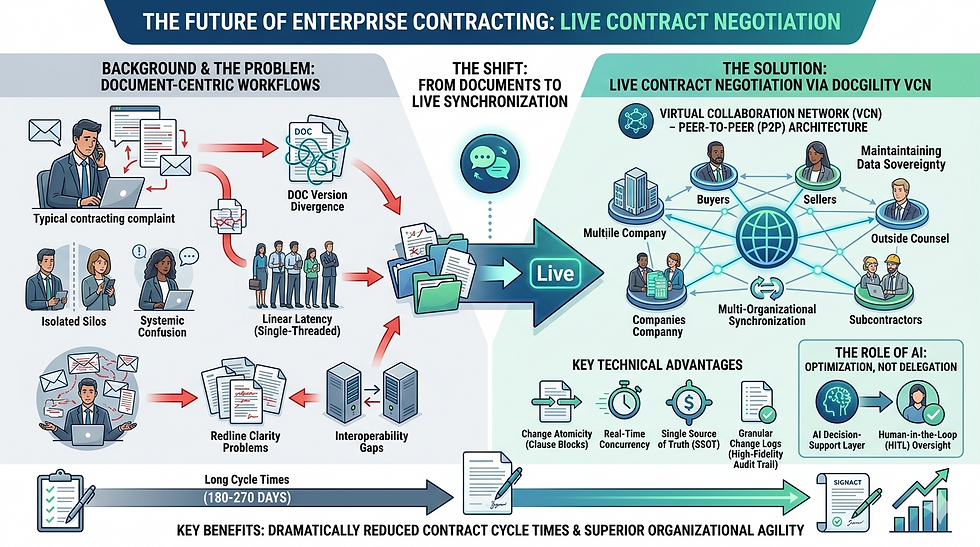
Docgility recently unveiled the Virtual Collaboration Network (VCN), a foundational technology designed to facilitate multi-party, multi-company live contract negotiations. This blog defines live contract negotiations and describes the technology approaches used to facilitate this key advance in contract negotiations.
Background
In the enterprise contracting ecosystem, the most important metric is Contract Cycle Time (the time between contract intent and executed contract). Live contract negotiation optimizes this metric by eliminating the structural latencies inherent in traditional document-centric workflows. By neutralizing the structural latencies inherent in asynchronous document exchange and version reconciliation, the VCN dramatically reduces contract cycle times and drives superior organizational agility.
"The moment a contract enters my inbox, its integrity is in question. Between fragmented redlines and asynchronous updates, the 'source of truth' vanishes. We are trapped in a cycle of proposing and approving changes without any real-time visibility into the actual status of the contract. The result isn't just a delay; it's systemic confusion born from a total lack of version transparency." - Typical contracting complaint
The Failure of Document-Centric Workflows
The current status quo relies on the asynchronous exchange of static files (Word or PDF) via email exchanges. This "document ping-pong" creates structural and systemic efficiency chokepoints:
Version Divergence: Asynchronous editing leads to fragmented "sources of truth," requiring manual reconciliation of conflicting redlines.
Linear Latency: The workflow is inherently single-threaded; concurrency is impossible when a file is "checked out" or sitting in a counterparty's inbox.
Redline Clarity: Redline histories in static files often lose the "why" behind the "what." Stakeholders frequently find themselves renegotiating terms settled in prior cycles due to a lack of integrated audit trails.
Interoperability Gaps: Contracting systems remain isolated silos. Without a common protocol, metadata and playbooks cannot be leveraged across organizational boundaries.
These inefficiencies result in protracted execution times—often exceeding 180 to 270 days for complex contracts—and a significant loss of organizational agility.
Defining Live Contract Negotiation
Live contract negotiation is the simultaneous synchronization of contract state across multiple authenticated entities. It replaces the exchange of files with the streaming of atomic changes.
Key Technical Advantages:
Change Atomicity: Changes are managed as discrete "sentence units" or "clause blocks" rather than character-level diffs. This allows for cleaner approval histories and clearer change audits.
Real-Time Concurrency: Multiple stakeholders—Legal, Finance, and Counterparties—can interact with the same contract simultaneously, providing immediate feedback loops and eliminating change latency.
Single Source of Truth (SSOT): The VCN ensures that all participants are viewing the most recent state of the contract, eliminating the need for manual version control and ensuring that all participants are viewing the latest contract state.
Multi-Organizational Synchronization: The VCN extends real-time collaboration and negotiation capabilities beyond internal silos to the entire stakeholder ecosystem. By integrating external entities—including outside counsel and counterparty organizations—into a unified data layer, the platform ensures that all participants collaborate on a single, authoritative state of the agreement.
Granular Change Logs: Every modification is timestamped and attributed, providing a high-fidelity audit trail of the negotiation logic.
The Peer-to-Peer (P2P) Imperative
A critical design consideration of Docgility’s VCN is its Peer-to-Peer architecture. Unlike centralized platforms that require all parties to surrender data to a single host, a P2P approach allows companies to interconnect digitally while maintaining data sovereignty.
The Trust Gap: External counterparties will often refuse to use a competitor’s centralized system. A P2P network facilitates trust by allowing each side to utilize their own internal playbooks, AI agents, and security protocols.
Contract Negotiation API: This standardized interface allows different systems to communicate, proposing and accepting changes programmatically, while maintaining separate data, security, and AI agent environments.
Federated Multi-Entity Authentication: Utilizing a secure, federated identity framework, the VCN enables seamless participation for external entities without compromising the integrity of the host’s internal security perimeter. This ensures that counterparties and counsel are authenticated and integrated into the negotiation flow with zero-trust rigor.
Hyper-Scalable Interoperability: The VCN’s peer-to-peer architecture enables the simultaneous interconnection of a vast ecosystem of thousands of companies—encompassing buyers, sellers, outside counsel, and subcontractors. By bypassing the inherent bottlenecks of centralized platforms, it establishes a universal, decentralized layer for real-time participation and total visibility across even the most complex, multi-company supply chains.
The Role of AI: Optimization, Not Delegation
While AI agents are integral to modern drafting and compliance—leveraging playbooks and historical datasets—they are not a panacea for broken workflows. AI can speed up the content generation and user contract review cycles, but it cannot fix the structural delays of email-based versioning.
In a live negotiation environment, AI acts as a decision-support layer. It provides real-time risk management and language recommendations that stakeholders can review and approve instantly. This maintains the necessary human-in-the-loop (HITL) oversight required for high-stakes business decisions while removing the administrative friction of document management.
Conclusion
The objective of any contracting system is to execute compliant agreements at the speed of business. Systems that fail to address the core issues of interoperability, versioning latency, and multi-party concurrency will ultimately remain bottlenecks. By moving from document exchange to live, P2P data synchronization, organizations can finally dramatically reduce contract cycle times and achieve true digital transformation in the legal department.
Comments